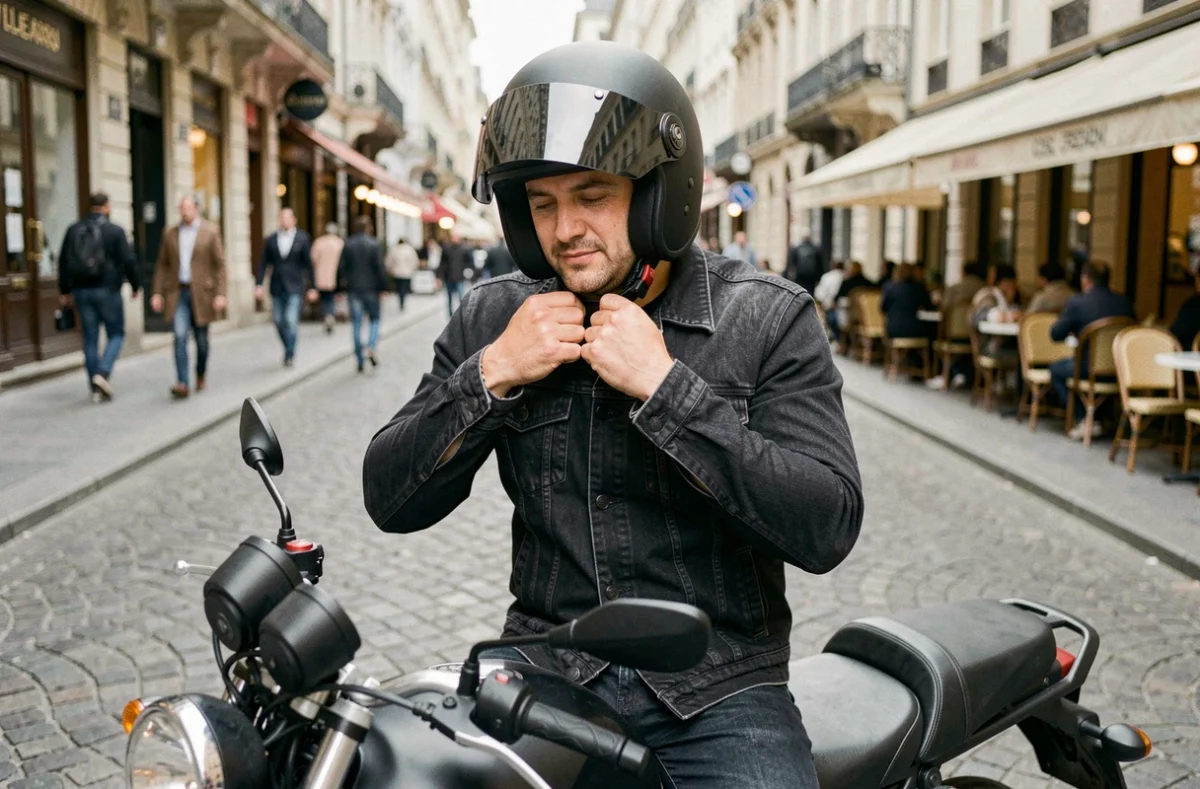
The jet helmet represents the majority of helmets worn in urban areas, on scooters as well as on small-displacement motorcycles. Its open shape appeals due to its lightness and field of vision, but daily comfort is not limited to these two parameters. Noise, fatigue, accessory compatibility, and regulatory constraints paint a more nuanced picture than that of product sheets.
Noise and fatigue at the handlebars: the overlooked weak point of the jet helmet
Most comparisons between jet and full-face helmets focus on protection in the event of a collision. Sound comfort, however, is rarely documented accurately, even though it directly affects the fatigue felt after a day of urban commuting.
The absence of a chin guard allows a continuous flow of air at the level of the face and ears. A Schuberth comparison published in September 2026 on MotorcycleHelmet247 reports a measurement of 85 dB(A) at 100 km/h for a specific model of Schuberth open helmet. This value, which should not be generalized to all jets, is at the threshold beyond which prolonged exposure can cause auditory fatigue.
In the city, speeds rarely exceed 50 km/h, which reduces aerodynamic noise. On the other hand, repeated accelerations at traffic lights and passages through narrow streets create sound variations that the brain processes continuously. As the same source reported, an open helmet can remain comfortable over long days but is less soundproof than a closed modular helmet.
For mixed city-peripheral journeys, where speed occasionally increases, user feedback diverges on this point: some users perceive no notable discomfort, while others describe a clear fatigue by the end of the day.

Accessories and ECE 22.06 standard: what the compliance of the jet helmet changes
Adding an intercom, a tinted visor, or a retractable sunshade to a jet helmet seems trivial. However, the ECE 22.06 standard complicates this habit, and a test conducted on the Autoscope fr site clearly details the practical implications of this regulatory evolution.
The ECE 22.06 standard introduces a specific verification of accessories mounted on the helmet. In practical terms, an integrated sunshade or an intercom mount must be provided by the manufacturer for the approved model. Installing a non-certified accessory for the helmet can compromise the compliance of the certification.
For daily urban use, the consequences are direct:
- A Bluetooth intercom attached to a jet helmet not designed for this accessory can alter the helmet’s behavior in the event of a collision, according to the criteria of the standard.
- A visor purchased separately, even if the right size, is not necessarily approved for the specific model of the helmet.
- ECE 22.05 helmets remain legal as long as they are marketed, but their gradual replacement by ECE 22.06 models makes the pool of compatible accessories increasingly limited.
Checking the list of accessories approved by the manufacturer before any additional purchase becomes a necessary step, not just an administrative detail.
Ventilation of the jet helmet in summer and winter: two opposing realities
The natural ventilation of the jet is often presented as an absolute advantage. In practice, it is an asset over a fairly narrow temperature range.
Between approximately 15 and 25 °C, the airflow on the face provides a pleasant sensation that clearly distinguishes the jet from the full-face helmet. This is the comfort window where the open format performs best.
When heat exceeds the comfort threshold
Above 30 °C, the warm air hitting the face dries out the eyes and skin. Ventilation becomes a disadvantage when the ambient air is warmer than body temperature. The inner foams absorb sweat, and without a directed ventilation system (present on some high-end full-face helmets), the jet helmet offers no directed cooling circuit.
Urban cold: a distraction factor
Below 5 °C, the exposure of the lower face causes numbness that reduces concentration. Accessories like neck gaiters or balaclavas partially compensate, but add a layer of equipment that the jet was supposed to avoid. The winter comfort of a jet helmet depends more on the added accessories than on the helmet itself.

Size and interior fit: the criterion that in-store trials do not reveal
A jet helmet tried on for five minutes in a store reveals almost nothing about comfort after an hour of daily wear. The inner foams compress over the weeks, and a helmet that seemed perfectly fitted can start to move slightly on the head.
The shape of the skull plays a decisive role. Two helmets of the same size from different brands do not fit the same morphologies. Manufacturers use inner shells of various shapes (elongated oval, round), rarely mentioned on the label.
- A helmet that is too tight at the temples causes headaches after twenty minutes, even if the head circumference is correct.
- A helmet that is slightly too large generates micro-movements with each braking, causing discomfort and distraction in dense traffic.
- The weight of the helmet amplifies any fitting defects: a lighter model tolerates an imperfect fit better than a heavier model.
User feedback on specialized forums confirms that a break-in period of two to three weeks is often necessary before truly assessing the comfort of a jet helmet. The foams gradually adapt to the morphology, and the initial sensation can evolve significantly, for better or worse.
The jet helmet remains a conscious compromise between openness and protection, between lightness and insulation. Its daily comfort in an urban environment depends less on the chosen model than on the fit between the wearer’s morphology, the temperature range of their journeys, and the care taken to ensure accessory compatibility. The available data do not allow for a conclusion that one format is universally superior to another for the city: each usage combination produces a different result.