
Which DIY tasks have the most errors among individuals, and which offer the best return on investment in learning time? The answer varies depending on the type of work, the level of regulation, and the cost of corrections in case of poor workmanship.
Electrical standards and compliance: what changes concretely for your projects
Most DIY guides treat electricity as just another tutorial. The regulatory reality is more stringent, and recent changes to the NF C 15-100 standard need to be understood before touching any circuit.
Circuits created or modified must comply with the current standard, without automatically requiring a complete overhaul of the existing installation. This distinction is often misunderstood: renovating an outlet in a kitchen does not trigger a global compliance requirement, but the circuit in question must be compliant.
For a new or fully renovated installation, a compliance certificate endorsed by the Consuel may be required before commissioning. In a partial renovation, only the circuits that have been redone are subject to applicable requirements. Consulting the work on bobolebrico.fr helps better frame the scope of a project before getting started.
On the fire safety side, the fire reaction requirements for cables depend on the type of building and the areas traversed. In certain public establishments (ERP), a decree from May 17, 2024, strengthens the constraints for projects whose permit or work authorization is after May 23, 2025.

Comparison table: accessible DIY tasks and tasks with regulatory risks
Not all DIY tasks present the same level of difficulty or the same consequences in case of error. The table below distinguishes tasks based on their actual accessibility and regulation.
| Type of work | Beginner access level | Regulatory risk | Correction cost |
|---|---|---|---|
| Interior painting | High | Low | Low |
| Installing floating flooring | Medium | Low | Moderate |
| Replacing a faucet | Medium | Low | Moderate (water damage) |
| Creating an electrical circuit | Low | High (NF C 15-100, Consuel) | High |
| Modifying load-bearing walls | Very low | High (structure, insurance) | Very high |
| Interior insulation | Medium | Medium (energy performance) | Moderate to high |
Painting remains the task with the most favorable learning/result ratio. The financial risk in case of failure is limited to the cost of materials. In contrast, an error on an electrical circuit can lead to a refusal of compliance and costs for a professional to rectify it.
Construction waste management: a constraint often ignored
Accumulating rubble, drywall scraps, or empty paint cans without an evacuation plan turns a controlled project into a logistical headache. The REP (extended producer responsibility) system for construction products and materials provides for a free collection under certain conditions for specific sorted waste.
The restructuring of this system, announced for 2026, has however been delayed following an opinion from the Council of State. Therefore, the collection methods vary according to local drop-off points. Before loading a utility vehicle, it is essential to check what the collection point accepts and under what sorting conditions.
- Inert waste (rubble, tiles, concrete) is generally accepted at municipal waste disposal sites, sometimes with a volume limit per visit
- Hazardous waste (solvents, oil-based paints, chemicals) falls under specific systems and should never be mixed with household waste
- Packaging for DIY products (silicone cartridges, glue cans) is subject to the REP system for chemical products based on their composition
Planning waste evacuation before the first hammer blow prevents being left with a cluttered garage for weeks.
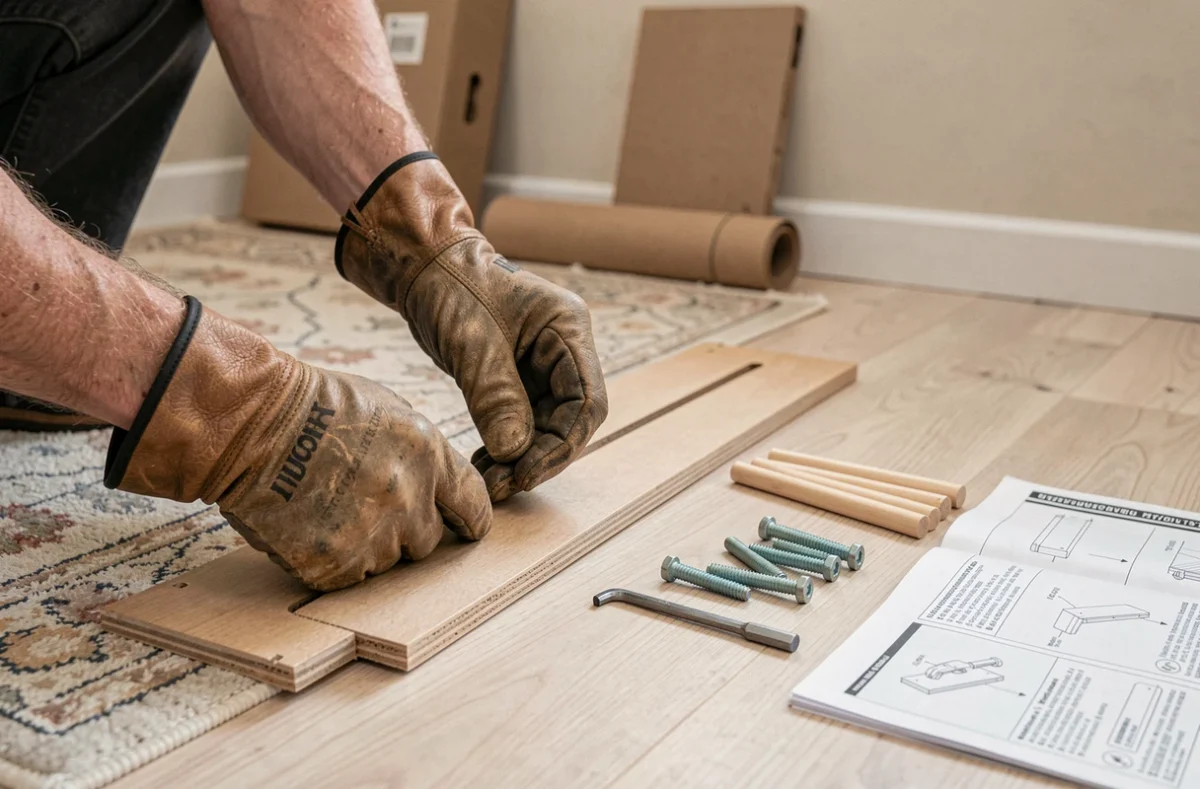
DIY tools: balancing versatility and specialization
The classic mistake of the beginner DIYer is to buy a specialized tool for every task. The opposite approach, doing everything with a single multifunction tool, yields mediocre results. The choice depends on the frequency of use.
A cordless drill/driver covers most common needs: drilling into wood, drywall, assembling furniture. A single well-chosen versatile tool replaces three low-quality tools. However, for precise cuts in solid wood, a dedicated jigsaw will produce a significantly better result than a multifunction oscillating tool.
The materials also dictate the choice. Drilling into concrete requires a hammer drill, not just a regular drill. Confusing the two damages both the tool and the material. Before each project, listing the materials to be worked on guides you toward the right equipment without unnecessary purchases.
Surface preparation techniques: the decisive factor for the final result
The quality of a finish depends more than half on the preparation work. Painting on a poorly sanded wall or laying a covering on an unlevel floor leads to visible defects within weeks.
- Filling cracks with an appropriate filler (filler for deep holes, smoothing compound for surface imperfections) is the first step in any wall renovation
- Sanding between each layer of filler with progressively finer grit (coarse grit then fine grit) ensures a smooth surface to the touch
- Applying a primer before the finishing paint improves adhesion and reduces the number of coats needed
Every hour invested in preparation saves two on touch-ups. This ratio explains why professionals often spend more time preparing than applying the finish.
Skipping the primer step on new drywall, for example, causes differences in absorption that leave visible marks once the paint is dry. The result may seem acceptable under direct lighting, but side lighting reveals every flaw.
Successful DIY relies less on dexterity than on following a logical order: diagnosing the substrate, preparation, choosing the right tool, execution, and then waste management. Neglecting any one of these steps compromises the results of the subsequent ones.