
400 milliliters correspond to 0.4 liters. The calculation is based on a division by 1000, since a liter contains exactly 1000 milliliters. This fixed relationship between the two units makes conversion immediate, provided you understand the mechanism behind it.
Moving the decimal point: the mechanism behind division by 1000
Dividing by 1000 means moving the decimal point three places to the left. For 400 ml, the whole number 400 becomes 0.400, or 0.4 L. This shortcut works for any value expressed in milliliters.
The principle relies on the decimal structure of the metric system. Each prefix (milli-, centi-, deci-) corresponds to a power of ten. The prefix “milli-” means one thousandth: 1 mL = 0.001 L. Multiplying this factor by 400 directly gives 0.4 L.
This logic also applies in the other direction. Converting from liters to milliliters requires multiplying by 1000, thus moving the decimal point three places to the right. 0.4 L becomes 400 mL again.
To delve deeper into the conversion of 400 ml to liters, just remember this rule of moving the decimal point, which avoids any mental calculation errors.
Milliliters to liters and centiliters conversion table
A reference table allows for quick verification of the most common equivalences. Instead of recalculating each time, keeping these values in mind speeds up work in the kitchen or laboratory.
| Milliliters (mL) | Centiliters (cL) | Liters (L) |
|---|---|---|
| 100 | 10 | 0.1 |
| 250 | 25 | 0.25 |
| 400 | 40 | 0.4 |
| 500 | 50 | 0.5 |
| 750 | 75 | 0.75 |
| 1000 | 100 | 1 |
400 mL is equivalent to 40 cL and 0.4 L. The centiliters column is obtained by dividing the milliliters by 10, and the liters column by dividing by 1000.
This table covers the volumes most commonly found on food packaging and in French recipes. Milk cartons, juice bottles, or cream jars may display either milliliters or centiliters, requiring one to juggle between the columns.
Common mistakes when converting mL to liters
The conversion is simple in theory, but several pitfalls arise regularly.
- Confusing division and multiplication: some multiply 400 by 1000 instead of dividing, resulting in 400,000 instead of 0.4. The rule is clear: to convert from mL to L, you always divide by 1000.
- Misplacing the decimal point: a shift of just one place gives 4 L instead of 0.4 L, which is ten times too much. In dosing household products or liquid medications, this error has concrete consequences.
- Mixing milliliters and centiliters: 400 mL does not equal 4 cL but 40 cL. The factor between mL and cL is 10, not 100.
EFSA reports that misinterpretation of volume units on food packaging (mL vs L) contributes to distorted estimates of nutrient intake, especially for beverages and ready-to-eat soups. This is not a problem reserved for beginners: the confusion between volume units also affects experienced consumers.
Converting 400 mL in the kitchen: weigh or measure
In the kitchen, the conversion between milliliters and liters raises another question: should you use a measuring cup or a scale? For water, the answer is indifferent since 400 mL of water weighs about 400 grams. The volume-mass correspondence is nearly perfect.
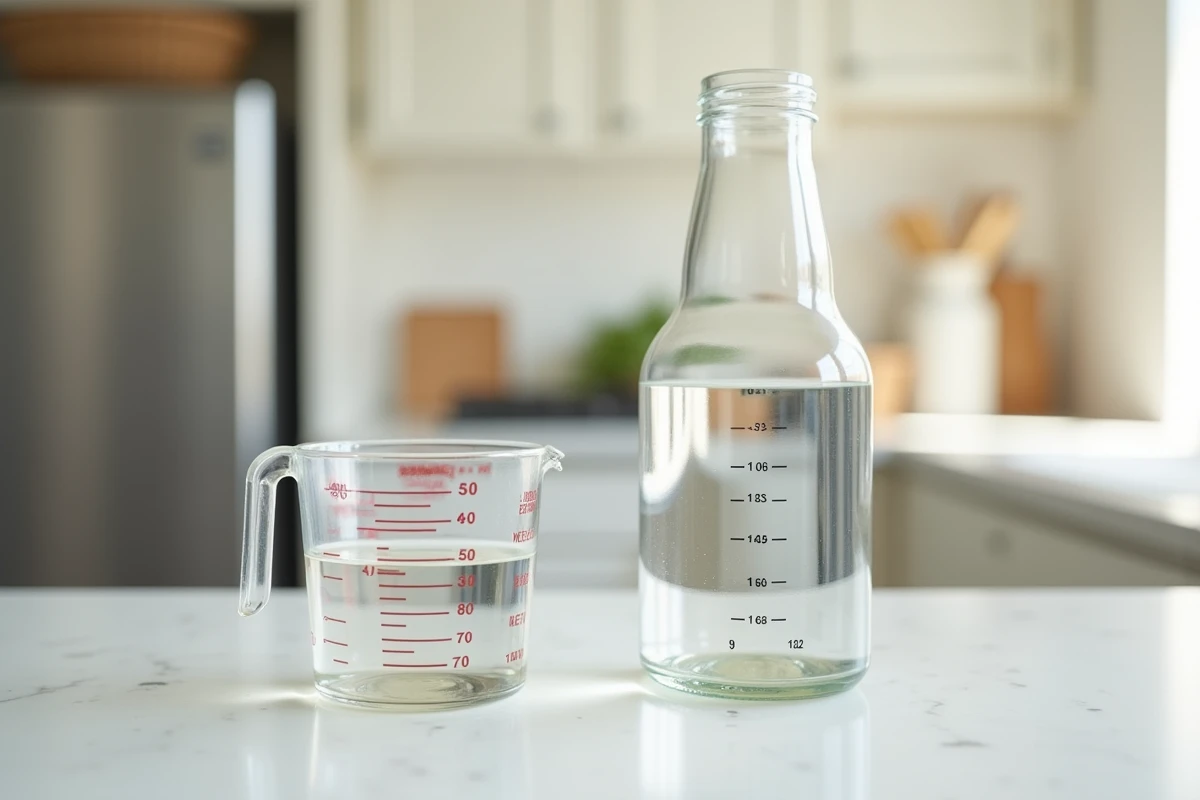
For milk, the density is slightly higher than that of water, meaning that 400 mL of milk weighs a bit more than 400 grams. The difference remains marginal in most recipes, but it matters in precision baking.
Densely packed ingredients (honey, oil, heavy cream) pose more problems. Density alters the relationship between volume and mass: 400 mL of honey weighs significantly more than 400 grams. In these cases, the recipe must specify whether it refers to milliliters (volume) or grams (mass).
- Water: 400 mL = about 400 g
- Whole milk: 400 mL = slightly more than 400 g
- Olive oil: 400 mL = slightly less than 400 g (density less than 1)
- Honey: 400 mL = significantly more than 400 g (density greater than 1)
Some connected kitchen scales now include mL to L converters directly in their interface. Entering a volume in milliliters displays the equivalent in liters or cups, reducing intermediate manipulations.
Digital tools for converting volumes without error
Online converters and mobile apps allow you to verify a conversion in seconds. Their utility goes beyond simple mL to L calculations: they also handle conversions to cups, fluid ounces (fl oz), or tablespoons, common units in Anglo-Saxon recipes.
Typing “400 ml to liters” in a search engine displays the answer without clicking on a result. Google, for instance, integrates a conversion widget directly into the results page. This feature covers volumes, masses, and temperatures.
Recent food processors also offer this function. Several consumer appliance brands have added an mL to L converter in the firmware of their devices, eliminating the need to switch between the recipe and a third-party app.
For recurring conversions in the kitchen or laboratory, a printed table stuck near the work surface remains the quickest method. No connection required, no screen to unlock: just glance at the right line and the measurement is done.
The conversion of 400 mL to liters involves one operation: divide by 1000. The result, 0.4 L, is useful for both adapting a recipe and checking a food product label. Where the calculation becomes more interesting is when the density of the ingredient comes into play, as the transition from volume to mass no longer follows the same rule.